'Fascination' and the non-metabolisation of jealousy

There is a whole spectrum of what I might call ‘negative emotions’ – viewed as such because of their potential for harmful consequences. These include cruelty, revenge, humiliation, contempt, and – perhaps one of the milder but no less potent for that – jealousy. All can be abusive and deeply damaging, but I believe it would be disingenuous to imagine a world where they do not exist. Some writing in the social sciences, gender and identity politics and elsewhere approaches such emotions in a strictly moralising way. Some of this may be warranted. But the question of how the existence of such emotions is acknowledged, rather than wished away, and how they might find expressive outlet without causing harm, is something often explored more fruitfully in art and culture, with their greater openness to the irrational.
Jealousy, as a consuming emotion but perhaps also one inherent to love, passion and desire, is the subject of ‘Fascination’, the penultimate track on Everything But The Girl’s debut album Eden (1984). It is a song not of present betrayal but of a predecessor: of the lover who came before, whose traces persist in memory, place and speech.
An earlier demonstration version was included on an expanded 2024 reissue of Thorn’s solo album A Distant Shore (1982):
This is, in that sense, absolutely Thorn’s song. It existed in her own version prior to EBTG’s formation, and can therefore largely be considered a solo composition later absorbed into the duo’s repertoire. More generally, the division of labour in EBTG tended towards Thorn doing most of the vocals and her collaborator and partner Ben Watt taking on most of the guitar work, as Thorn notes in her memoir Bedsit Disco Queen (2013). It is not clear who plays guitar on the Eden recording, but that matters less than the song’s evident origin in Thorn’s own earlier demo.
I loved the early work of EBTG from when it was new, but this track always held a particular appeal. While some of the repeated bossa nova patterns and rather tame appropriations of 1950s and early-1960s jazz elsewhere on the album, so characteristic of sophisti-pop, can lose some of their appeal over time, this song does not. It has both intimacy and dark passion, and uses economical means to convey complex and deep feelings. Above all, its understanding of jealousy is unusually exact. What it captures is not melodrama but inward strain: the effort to remain civil, composed and generous while pain keeps working beneath that composure - a response to jealousy that, as we shall see, is far from the only one available, even within the work of Thorn’s own collaborator.
The song and its workings
The song is deceptively simple. It is organised largely around two oscillating guitar harmonies, rather than any strongly directional harmonic progression. In this sense it stands within a long tradition of jazz and popular music, with the most prominent classical predecessor being Erik Satie’s Gymnopédies. The meter is in five, and the 3+2 rhythm, a syncopation across three beats followed by two straight beats, is identical to that in Dave Brubeck’s Take Five (1959), though where Brubeck shifts harmony between the 3- and 2-group, in ‘Fascination’ a single harmony is sustained across the whole bar before being repeated; the irregular pulse of 5 is balanced by a resolution into duple units at a higher level. In the Eden version (Fig. 1), the first chord is Cmaj9 (no5), the second, not easily conveyed through traditional chord symbols, but made up of F3-B3-D4-E4, a heavily modified subdominant harmony with considerably more inner tension than the previous chord. It could conceivably by an extension a G13 chord without the root (far-from-uncommon as a jazz harmony), but when Thorn enters and most phrases there begin with A3, that overrides such a hearing. The ceaseless oscillation between these two harmonies – one relatively settled, the other taut with unresolved strain – becomes a direct musical analogue for the song’s emotional subject: the alternation between performed composure and the jealousy quietly eating the singer from within.
The song is constructed out of three verses, between the second and third of which there is a bridge, including a saxophone solo (another almost manneristic cliché of sophisti-pop, in this case mostly a free riff on some of the melodic motives). In the second and subsequent verse the second chord changes to F3-G3-B3-E4, which in a rather contorted notation is Fmaj9(#11) (no3,no5) but is more simply an F root with an E minor triad in 6-3 position. This formation softens the stark F3-B3 tritone of the earlier chord, and so conveys a somewhat greater degree of warmth. The addition of extra repetitions, through a second guitar track, adds momentum and textural expansion to the music and a consequent sense of increased anticipation and trepidation.
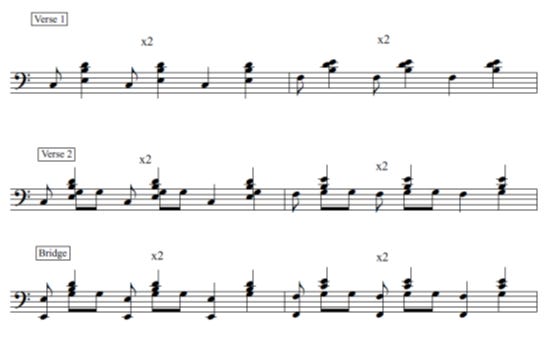
Fig. 1. ‘Fascination’ (version on Eden), basic harmonies.
The chord sequence changes more fundamentally for the vocal section of the bridge, now alternating Em7 (no5) with the root doubled an octave above and F3-G3-C4-E4, which can be conceived as Fmaj9 (no3), or simply an F root with a C major triad in 6-4 position. The sax solo is accompanied by a return to the original pair of oscillating chords. The sax continues playing through verse 3 to the end, and at the end of that verse (on the first ‘mind’) the music shifts back to the chords of the bridge, finally settling on the second of these.
The earlier demo version (Fig. 2) is a little different. In D-flat rather than C (possibly using a capo), it demonstrates the genesis of the chordal pairing in the later version. The opening harmony is D-flatmaj9 (no5) again, but the third degree is here an octave higher, so that the upper trichord is identical in alternating bars, just the root shifts. The fifth enters like an extra line within Verse 1, anticipating the quaver patterns in Verse 2.
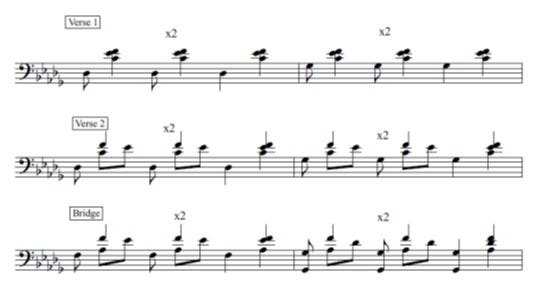
Fig. 2. ‘Fascination’ (demo version included on expanded release of A Distant Shore), basic harmonies.
The full lyrics can be read here. Thorn sings about the pain of knowledge of a lover’s past and the impossibility of erasing memory (‘I won’t try to stop you when you speak of the past’, ‘There must be so much I know that you cannot forget’), combined with the desire to know more even when such knowledge will hurt (‘Fascination makes us ask for more than we’d like to know’). The song oscillates between this almost morbid appetite for knowledge and its denial (‘Reassure me when my heart’s not bold enough to bear her name’, ‘And though I may ask there’s no need for past details’) and between outward performance of composure and inward collapse (‘Doubt is over now and I can join in when you laugh’, suggesting self-persuasion more than report, ‘For though I may laugh, alone my courage fails’, ‘See how I’ve changed now my head’s so clear / Still there are some things that I don’t want to hear’). The jealousy becomes a wish to occupy the lover’s mental and physical space, while recognising this can never fully happen (‘Places we go remind you of when you were here before / So you talk and tell me you don’t think about it anymore’). The bridge section expresses the greatest urgency (‘See how I’ve changed’) but then resolves back to the initial chords with the poignant admission ‘And I mustn’t wish your life began the day we met’: the irrational but human fantasy of becoming retroactively central to the beloved’s whole existence. The final repetition, ‘to prove that I don’t mind’, is quietly devastating because it asks for the impossible. What she seeks is not proof that the past is harmless, but proof from the beloved of her own composure: proof that she can be the generous, mature, unjealous self she wishes to be. The repetition is almost ritualistic: she asks again not because reassurance works but because it does not.
The musical scansion of the text (Fig. 3), and its relation to relative tension and release, are used for intense expressive effect. There is very little of the soul-infused style in which a singer continually displaces notes from strong beats. Thorn is far more direct and measured, and her restraint suggests an ability to convey vulnerability without ornamenting it. The tension arises less from overt vocal display than from the complexity and inner contradiction of the feelings themselves.
Verse 1
I won’t try to stop you when you speak of— the past
Doubt is o-ver now and I can join in when you laugh
Fas-ci-na-tion makes us ask for more than— we like to know
I nee-dn’t ex-plain, I think you— know
Verse 2
Re-as-sure me when my heart’s not bold e-nough to bear her name
If you were in my shoes—and scared I would do the same
And though I may ask there’s— no need for past de-tails
For though I may laugh, alone my cou-rage fails
Did you— know?
Bridge
See how I’ve changed now— my head’s so clea-r-
Still there are some things that I— don’t want to hear
There must be so much I— know that you can-not for-get
I must-n’t wish your life be-gan- the day we— met
Verse 3
Pla-ces- we go re-mind you when you were here be-fore
So you talk and tell me you don’t think- a-bout it any-more
There is some-thing I know— ha-sn’t quite been left be-hind
So I’ll ask you once a-gain to prove that I don’t mind—
To prove that I don’t mind—
Fig. 3. Musical scansion of ‘Fascination’. Within a 3+2 regular rhythm, those syllables marked bold are on the strong downbeat, so beginning of the set of 3 beats, those in italics on the medium-strong fourth beat, so beginning of the set of 2 beats.
In several lines (‘you speak of— the past’, ‘more than— we like to know’, ‘things that I— don’t want to hear’, etc.), Thorn elongates a pronoun, preposition or conjunction, or the word ‘know’ itself, delaying what is hard to speak. The hesitation before ‘met’ at the end of the bridge creates a momentary haze, as if she wants this to mark a firm ‘beginning’ while knowing that it cannot do so in the face of what came before. A few lines, while not avoiding strong or medium-strong beats entirely, evade several of them, creating a heightened sense of ambiguity and uncertainty, especially at the end of each verse (‘I think you know’, ‘Did you know?’). In the three verses, the second half of each line generally coincides with the harmony of greater tension, sharpening the pain in ‘you speak of the past’, ‘I can join in when you laugh’, and especially ‘when you were here before’, perhaps the emotional peak of the song. In the bridge, by contrast, it is the first chord that carries the greater tension, lending clarity of intent to ‘my head’s so clear’ and ‘I don’t want to hear’, and resignation to ‘you cannot forget’.
The basic melody for all three verses is mostly restricted to a tessitura of G3-E4. It is made up of variants on two antecedent/consequent phrases, indicated as (a) and (b) in Fig. 4a, sometimes staggered with the wider metrical units. The first is 7 beats, reducing to 6 in the last line, beginning with an oscillating resolution of the leading note, then from the second line introducing the missing fifth degree, so that the oscillation between this and the leading note is more significant; the second 10 beats at first, then 12 from the third line, as it settles into a resolution (as the singer eases and gains confidence), expressing yearning through an ascending contour over the more dissonant harmony, in which context some of the strong beats (A3, C4) on one hand fill out a more conventional Fmaj7 chord, but also acting as neighbour notes onto the pitches of the accompaniment, in the process creating another level of tension.
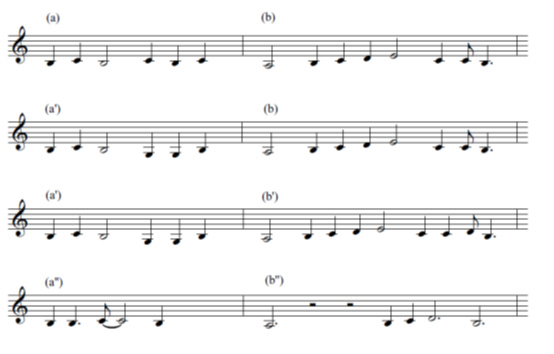
Fig. 4a. Melodic fragments of Verse 1.
Verse 2 essentially consists of continuing variants, the change being most striking when Thorn affirms that she would do the same if the roles were reversed. But from the second line the ascending lines are more restricted, never extending above D4, a pattern which continues in Verse 3 (though the Bridge has gone higher), until the final word ‘mind’, closing the song with the renewed yearning and uncertainty after an earlier increasing sense of resignation.
The bridge introduces a new antecedent fragment (c), essentially a repeated note preceded by an anacrusis of the same pitch an octave lower. The repetition, now on the more dissonant harmony, adds an emphatic quality. Then the consequent (d) is essentially a variant of (b) using a reduced tessitura. Then a hybrid of (c) and (a) in the second line leads to a return to (a) in the third, and further variants in the fourth.
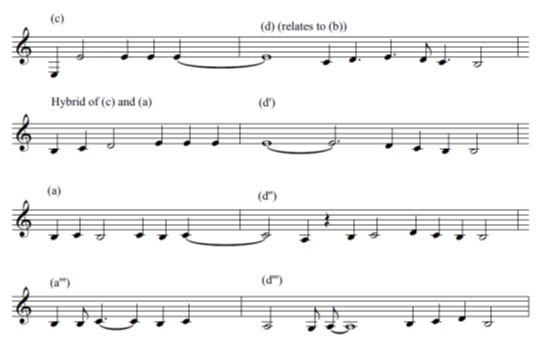
Fig. 4b. Melodic fragments of Bridge.
Fig. 5, from the beginning of verse 2, shows various indicative properties of the song. The verse begins on the Cmaj9 harmony with clear strong and medium-strong emphases for the definite wish for reassurance, then the increased tension as Thorn nonetheless sings outright, with similar rhythms, about the pain of simply hearing the name of the former lover. When trying to offer mutuality in the next line, the elongation of ‘shoes and scared’ and displacement of a clear downbeat with the harmonic shift expresses the doubts about projecting her feelings onto the other. Thorn gives special vocal emphasis to the ‘I’ followed by ‘would do the same’, but ‘same’ comes marginally before the downbeat, causing the firmness of intent to dissipate slightly during the course of the phrase.
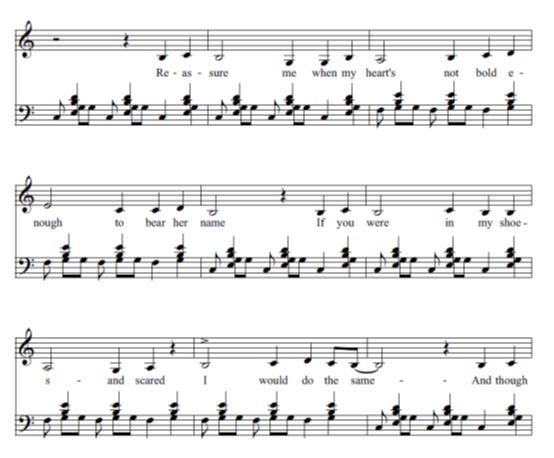
Fig. 5. ‘Fascination’, beginning of second verse.
Jealousy in context
Jealousy, which originates in the Greek word zēlos, meaning ‘zeal’ or ‘fervent pursuit’, has an immense literary history. But ‘Fascination’ belongs less to the world of melodramatic jealousy than to that of inward, self-scrutinising, almost ashamed attachment. It is not Othello, The Winter’s Tale or The Kreutzer Sonata, where jealousy moves rapidly towards violence and catastrophe; not the harsh destruction of Simone de Beauvoir’s first novel L’Invitée/She Came to Stay (1943), in which Françoise’s jealousy takes the form of sovereignty threatened by the freedom of another, leading to the wish to manage, contain, possess and ultimately annihilate. The song belongs instead to a lineage in which jealousy is sustained by imagination, by signs and memory, by the painful knowledge that the beloved has had experiences one can never fully master or enter, and in which the lover is drawn repeatedly to what causes pain. The song does not call itself ‘Jealousy’ but ‘Fascination’ - and this substitution is exact. It names what Mario Praz, in The Romantic Agony (see below), called the Medusan pull: the face that should repel but instead compels, the compulsive half-pleasured quality of jealous curiosity rather than its painful surface. Thorn’s title carries that same logic into the register of everyday erotic life.
Georg Simmel, in ‘The Sociology of Conflict’ (1904), offers a particularly sharp distinction between envy and jealousy which helps clarify the emotional structure of ‘Fascination’. While envy, for Simmel, is directed chiefly towards the desirable object itself; jealousy turns upon the rival possessor, and presupposes some sense of claim - legal, moral, emotional, or simply felt - upon the person whose love or recognition is at stake. He writes that ‘the susceptibility of the envious turns rather upon the thing to be possessed, that of the jealous upon the possessor.’ What gives jealousy its particular bitterness is that the rival seizes precisely the point of union between self and beloved, so that antagonism arises not outside the relationship but at its very centre. This is highly pertinent to ‘Fascination’: Thorn is not simply envying a predecessor, but suffering from the thought that another woman has already occupied the place of intimacy, memory and recognition to which she herself lays claim; and since love cannot be commanded, the song turns instead to the external signs of reassurance, proof and persistence.
Jealousy permeates much of Proust’s À la recherche du temps perdu (1909-27), as a painful mode of interpretation and projection which turns uncertainty into ever new scenes. Throughout La Prisonnière, the narrator Marcel is overwhelmed by jealous feelings for Albertine and the knowledge of other erotic opportunities available to her in Paris, leading to forms of surveillance and attempts to imprison her in his apartment. Yet the more he seeks mastery, the more she recedes into opacity, so that he can feel closeness and pleasure only when she is asleep. Even after her death, in Albertine disparue, he remains desperate to possess her further in his mind, while knowing that he can never understand the nature of her lesbian desires and encounters from the inside. Earlier, in Du côté de chez Swann, jealousy is once again linked to imagination and the will to possess: Swann laments the years spent pining over a woman, Odette, he wanted to be something she was not. Gilles Deleuze, in his Marcel Proust et les signes/Proust and Signs (1964, rev. 1972, 1976), radicalises this account by describing jealousy as a ‘delirium of signs’. The jealous lover reads gestures, words, silences, objects and places as clues to ‘possible worlds’ harboured within the beloved, worlds which can be intuited and elaborated but never fully entered. In my essay ‘Coldness and Cruelty as Performance in Deleuze’s Proust’ (published in Beckett’s Proust/Deleuze’s Proust, edited Mary Bryden and Margaret Topping (2009)), I relate this to a form of supposed domination by which a submissive deploys signs – bodily, verbal, and sometimes involving objects, location, smells - to stimulate the imagination of a dominant, extending and intensifying more conventional techniques of seduction, opening out the latent or possible. Deleuze expands the argument in Différence et repetition/Difference and Repetition (1968), where he writes of love as arising from ‘the revelation of a possible world as such, enwound in the other which expresses it’, so that jealousy becomes an imaginative and coercive labour: an attempt to decipher, inhabit and perhaps master the possible worlds of the beloved. Julia Kristeva, in her essay ‘Le temps, la femme, la jalousie, selon Albertine’ (2007), remains with Proust but gives jealousy a different inflection: as bound up with narration itself, the effort to construct a plot in order to displace an absence. Both perspectives matter for ‘Fascination’: the song circles around a predecessor who is scarcely described, but whose shadow lies over the whole emotional narrative. The beloved, shadowed by this predecessor, becomes what Proust called un être de fuite — a being of flight, whose opacity is not accidental but constitutive.
Anne Carson, in her book Eros the Bittersweet (1986), brings one much closer to the emotional pitch of the song. Carson looks to Sappho’s word glukupikron especially in fragment 130 of the Poetarum Lesbiorum Fragmenta:
Eros once again limb-loosener whirls me
sweetbitter, impossible to fight off, creature stealing up
Carson preserves Sappho’s ordering, ‘sweetbitter’ rather than the more conventional ‘bittersweet’ in English, to convey not merely that sweetness can turn sour, but that both sweetness and hurt are entangled from the outset. Desire for Carson depends upon distance, lack, postponement: upon a gap between lover and beloved which both wounds and sustains at the same time. One wants what one cannot wholly have: if the gap were simply abolished, desire itself would begin to fade (as she argues through a reading of Plato’s Phaedrus).
She frames desire as a triangle between the lover, the beloved, and that which comes between them, which are ‘three points of transformation on a circuit of possible relationship, electrified by desire so that they touch not touching’. In ‘Fascination’, the beloved is never encountered simply in an immediate fashion, but is always shadowed by his earlier attachment, the lover’s predecessor, and by remembered places and associations that remain part of him. The desire is intensified precisely by that interval which cannot be closed. What wounds the singer is also what sustains desire: the gap between herself and the beloved’s prior life is not incidental to the love, but one of the very conditions under which it continues to burn.
Carson’s reading of Sappho’s fragment 31, in a key chapter on the ruse, is even more directly relevant:
He seems to me equal to gods that man
whoever he is who opposite you
sits and listens close
to your sweet speakingand lovely laughing—oh it
puts the heart in my chest on wings
for when I look at you, even a moment, no speaking
is left in meno: tongue breaks and thin
fire is racing under skin
and in eyes no sight and drumming
fills earsand cold sweat holds me and shaking
grips me all, greener than grass
I am and dead—or almost
I seem to me.
The man sitting opposite the beloved, who listens to his speaking and laughing, is not incidental. Carson calls him ‘a cognitive and intentional necessity’, the third figure who makes visible the distance between lover and beloved and thereby helps to constitute desire itself. This is the role occupied by the predecessor in ‘Fascination’: she is absent, but psychically vivid; her invisible presence is the condition of the song’s jealousy.
René Girard offers a more rigorous model of triangulation than Carson. In Mensonge romantique et vérité romanesque/Deceit, Desire, and the Novel (1965), desire does not run directly from subject to object, but is always mediated by another person, who confers value upon the object, as with the knight errant Amadis of Gaul for Don Quixote. Where this mediation is internal, and mediator and subject inhabit the same social world, the mediator becomes a rival; desire thereby turns jealous. One no longer wants simply the beloved, but what the rival seems already to have possessed: precedence, intimacy, prestige, a superior claim, resulting at its most extreme in metaphysical desire, a form of obsession, vanity, sadism and masochism, and inner torment. Jealousy once again becomes not only fear of loss but humiliation before another’s prior occupancy of the desired place.
This model fits ‘Fascination’ with particular force. Thorn experiences her beloved through the shadow of his former lover; knowledge of that former intimacy heightens his desirability even as it wounds, because the predecessor has already occupied the place Thorn now seeks to occupy. The beloved’s past becomes denser, more glamorous and more inaccessible as a result. Even places bear traces of earlier scenes, and so acquire a painful symbolic force.
Melanie Klein, in her essay ‘Envy and Gratitude’ (1957), helps refine the emotional texture of this jealousy. What matters in ‘Fascination’ is that the beloved remains, in Kleinian terms, a good object: loved, valued, not attacked or degraded, even while experienced as precarious and not wholly secure. Thorn does not seek to spoil or punish him; rather, she suffers from the sense that his love, memory and inward attachments are not fully available to her because they have already been shared, and perhaps not wholly relinquished. This helps explain the song’s unusual tenderness. Its jealousy is possessive and wounded, but not vindictive; it is governed less by aggression than by anxious dependence and the pain of incomplete possession.
There is also a longer genealogy for such entanglements of pain and attraction. In La carne, la morte e il diavolo nella letteratura romantica/The Romantic Agony (1930), Mario Praz traces the Romantic and post-Romantic fusion of beauty and love with suffering, eroticism with mortality, and desire with cruelty, from the nineteenth century cult of Medusa through the work of Byron, Keats, Flaubert, Baudelaire, Swinburne and D’Annunzio, showing how deeply nineteenth-century literature aestheticised torment, fatality and the compelling nature of hurt. Denis de Rougemont, in L’Amour et l’Occident/Love in the Western World (1939), argues that Western romantic love is constitutively oriented toward obstacles and suffering. Camille Paglia, in Sexual Personae: Art and Decadence from Nefertiti to Emily Dickinson (1990), inherits much from Praz while giving it a broader, quasi-anthropological sweep: for her, erotic life is permeated and structured by conflict, humiliation, distance, fascination and power, in which context she also interprets Sappho’s fragment 31. ‘Fascination’ obviously inhabits a far quieter world than those described by Praz, de Rougemont or Paglia, but it still belongs, in miniature and in a chastened late-modern idiom, to this longer history of romantic agony: a muted, civilised form of resignation before what cannot be controlled. Each of these traditions traces metabolic outlets for jealousy - into violence, aestheticised torment, narrative obsession, compulsive repetition, or destructive possession. ‘Fascination’ is defined by its refusal of all these transformations.
Georges Bataille, in L’Érotisme/Eroticism: Death and Sensuality (1957), takes desire in a still more radical direction. For Bataille, erotic life depends upon taboo (modesty, shame, restrictions on nakedness make eroticism possible), transgression, shame and the disturbance of bounded, self-identical being; erotic intensity is tied to a partial dissolution of the composed, separate, discontinuous self. Even so, he illuminates one aspect of ‘Fascination’: the singer cannot experience her lover as entirely discrete from his previous attachments, cannot feel him as wholly and cleanly hers, and it is precisely this failure of secure discontinuity that keeps desire alive while making it painful. ‘Her name’ is the symbol of the earlier lover’s discrete existence. Thorn’s register of humility, non-dramatised vulnerability, maturity belongs fully to the glukupikron, the inseparability of sweetness and bitterness. But such maturity allows her no means of metabolising the pain; it turns inwards instead.
But one of the sharpest lenses for ‘Fascination’ can be found in Roland Barthes’s Fragments d’un discours amoureux/A Lover’s Discourse (1977). Barthes anatomises not love as social institution or metaphysical truth, but the inner speech of the lover: its hesitations, recursive tests, shame, sudden images, humiliations and repetitions. Jealousy, he says, involves ‘three permutable terms’: the lover, the beloved and the rival. Yet the rival is not simply hated. He or she is magnetic, fascinating, because it is through that figure that the beloved’s opacity and desirability become more acute.
That is exactly the paradox Thorn sings. She does not want ‘past details’, yet keeps circling back to them masochistically; she asks for reassurance, yet reassurance cannot quite abolish the wound; she wants to appear composed, generous, unthreatened, yet she remains caught in comparison. Barthes also writes of suffering jealousy ‘four times over’: through jealousy itself, shame at being jealous, fear of hurting the beloved through one’s jealousy, and shame again at being trapped in such a drama. This formula captures with extraordinary precision the emotional register of ‘Fascination’. Thorn’s suffering is not only caused by the rivalised past, but by her own recognition of herself as jealous.
What Thorn does with all this is remarkably precise. Her predecessor becomes, as in Sappho, a structurally necessary third term; as in Girard, a mediator who heightens desire by having come before; as in Barthes, a figure of fascination as much as pain. Yet the beloved remains, in Klein’s terms, a good object - loved, not attacked, not degraded - and the jealousy never curdles into the wish to spoil or punish. The song holds these traditions together without strain, even though the narrator need not know that she is doing so, and remains a quiet form of romantic agony.
Jealousy, Tracey Thorn and Ben Watt
Ben Watt covered a similar theme in ‘Thirst for Knowledge’ on his own solo album North Marine Drive (1983) – ‘I cannot bear the thought of someone touching you / Even in the days I never knew / A thirst for knowledge is the thing that drives me on’. But Watt’s tone and high tessitura are more anxious, anguished, somewhat panicked. Thorn’s is more sublimated. The anxiety is no less intense, but is filtered through a need to perform civility, composure and erotic self-command, where Watt sounds more openly stricken. Arguably, his more ‘externalising’ tone and overt emotionalising (arguably more transgressive for a man) may enable a greater degree of metabolisation. By contrast, Thorn’s composure impresses as a chosen aesthetic strategy: the glukupikron as craft rather than compliance, but amounting to a form of compelled sublimation.
Thorn and Watt appear to have become a couple during their first term at Hull University in 1981, when both would have been eighteen or nineteen. Little is known of either’s earlier romantic life. Watt has spoken of having had ‘quite a lot of ex-lover baggage… which was quite awkward and unpleasant’ before meeting Thorn. Thorn, by contrast, recalls in her memoir of teenage years, Another Planet (2019), adolescent crushes, snogging, efforts to impress boys, being dumped, and the attempt to tell herself in her diaries that she had ‘never fancied him anyway’, but gives little sense of anything more sustained. An autobiographical reading of ‘Fascination’ therefore remains speculative. One possible context is Thorn’s attempt to come to terms with Watt’s ‘baggage’; another is that the song inhabits a largely fictional or composite world.
‘Fascination’ is unlike many other jealousy songs, except perhaps ‘Thirst for Knowledge’. It is not about active betrayal or present erotic contest, but about the existence of a predecessor - a woman whose name the narrator cannot bear to hear, whose prior occupancy of the beloved’s life cannot be undone. Thorn’s smooth voice, moving within a restricted tessitura and avoiding any overt inflation of emotional temperature, performs the composed exterior that the lyrics steadily betray. The vocal manner is essential to the meaning: Thorn never strains towards expression, never reaches for effect. The pain is more present for being controlled than it would be if directly stated.
Thorn recognises that there may always be part of her lover’s inner life to which she does not, and cannot, have full access: memories, associations, prior attachments, scenes that remain beyond her, even if the earlier relationship is over. What troubles her is not simply the possibility that this part of his heart might return to another, but the fact that it cannot be made not to have existed. That irreversibility wounds her, but it also keeps desire alive: love here is animated by the very knowledge that full possession is impossible. The song does not resolve this. It subjects jealousy to decorum - the composure she performs, her willingness to listen, to laugh along, to remain reasonable - and then quietly admits that decorum is not enough. The pain lies in the gap between performed equanimity and the admission that her courage fails.
That admission is so undramatic that it takes a moment to register as the most honest thing in the song. Thorn does not dramatise jealousy through accusation, revenge or collapse; instead the song enacts pain through restraint. This gives it its peculiar force: it is at once intimate and withheld, candid and ashamed, tender and quietly self-wounding. It is the glukupikron in its most unspectacular and most devastating form: the ache is the love, the love is the ache, and the song would not be about either if it were not, irreducibly, about both. It is in the gap between desire and knowledge, composure and inward pain that its emotional power resides. Few songs render so unspectacularly, and so piercingly, the pain of loving what one cannot fully possess.
With thanks to Sarah Hill, Julian Horton, Caroline Potter and Kenneth Smith for some feedback on earlier drafts.
ADDENDUM: Since publishing this article, I realised there was a very different way of reading this song. I have detailed this in a follow-up article here.